
Laser hair removal or IPL: what is the real difference?
Laser hair removal and intense pulsed light (IPL) are two distinct technologies. The laser emits a single wavelength, chosen to be absorbed by the melanin in the hair. IPL emits a broad spectrum of light, only part of which is useful for hair removal. This physical difference has direct consequences for precision, effectiveness and suitability for different skin types. At the Centre Laser Valbonne, we mainly use the SUBLIM® Mono laser, a diode laser. Understanding these differences helps you make an informed choice.
What is the physical difference between a laser and IPL?
A laser produces light of a single wavelength, emitted as a concentrated beam. IPL (Intense Pulsed Light) produces light made up of many wavelengths, generally between 500 and 1,200 nanometres, like a very powerful flash lamp. Filters can narrow this spectrum, in particular by removing the shortest wavelengths, but the light emitted remains a more or less broad band of wavelengths. The laser therefore concentrates all its energy on the useful wavelength, whereas IPL, even filtered, spreads it over a wider part of the spectrum.
Why does this physical difference affect treatment effectiveness?
Because it is more selective, the laser can deliver high energy to the follicle while better sparing the skin. IPL, part of whose light is absorbed by the skin itself, often has to be used at lower energies to avoid burns, which limits the destruction of follicles. In practice, the laser is generally more effective and requires fewer sessions. Whatever the technology, blond, red or white hair responds poorly.
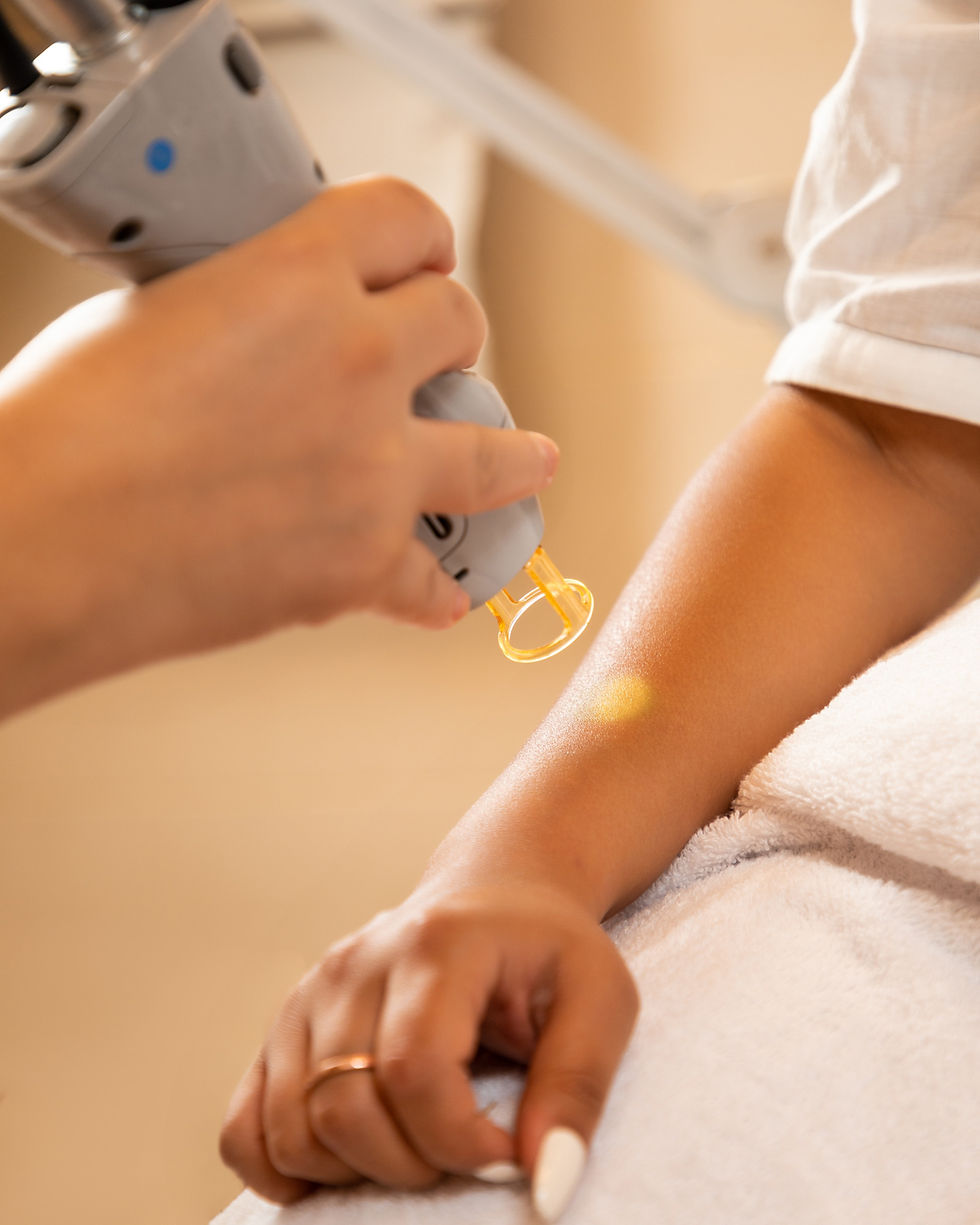
There is also a practical difference. With the laser we use, the treated area remains visible throughout the session: you can see exactly where the handpiece is passing, and a missed hair is easy to spot. IPL is generally applied with a large handpiece placed directly on the skin, over a layer of gel, which obscures the hairs and limits the precision of the treatment.
Can IPL be used safely at home?
IPL devices sold for home use have deliberately limited power to reduce the risk of burns or marks. Their results are therefore more modest and less lasting, and they must be used regularly. Above all, there is no prior examination to identify a contraindication: olive or dark skin, a photosensitising medicine, a mole or a skin condition on the area. At the Centre Laser Valbonne, every treatment is preceded by a free medical consultation that identifies these situations.
Which phototypes are compatible with IPL and the laser?
IPL gives its best results on fair skin with dark hair (phototypes I to III). On olive or darker skin, the melanin in the skin absorbs a larger share of the light, with an increased risk of burns and marks. The diode laser, being more selective, suits a wider range of skin, from the fairest to slightly olive skin. At the Centre Laser Valbonne, we treat skin types up to phototype IV. Dr Milène VERA assesses your phototype at the consultation.
Frequently asked questions
Does IPL give long-lasting hair removal? IPL can reduce hair growth, but it is generally less effective than the laser and requires more sessions, as its energy is spread over a broad spectrum of light.
Is the laser more painful than IPL? Both cause a feeling of warmth or tingling, which depends mainly on the area treated and on individual sensitivity. Recent diode lasers include skin cooling, which improves comfort. On the most sensitive areas, Dr VERA can also prescribe an anaesthetic cream to apply before the session.
Can I switch from IPL to laser? Yes, of course. A treatment started with pulsed light can perfectly well be continued with the laser. The preliminary consultation assesses your current hair growth and adapts the treatment course.
Who can carry out laser or pulsed light hair removal in France? Since the decree of 24 May 2024, non-therapeutic laser and pulsed light hair removal can be carried out by doctors, but also by nurses and qualified beauticians who have completed compulsory training.
Free and compulsory preliminary consultation — booking via Doctolib. Book an appointment on Doctolib


Comments