
Diode, alexandrite or Nd:YAG laser: which technology for hair removal?
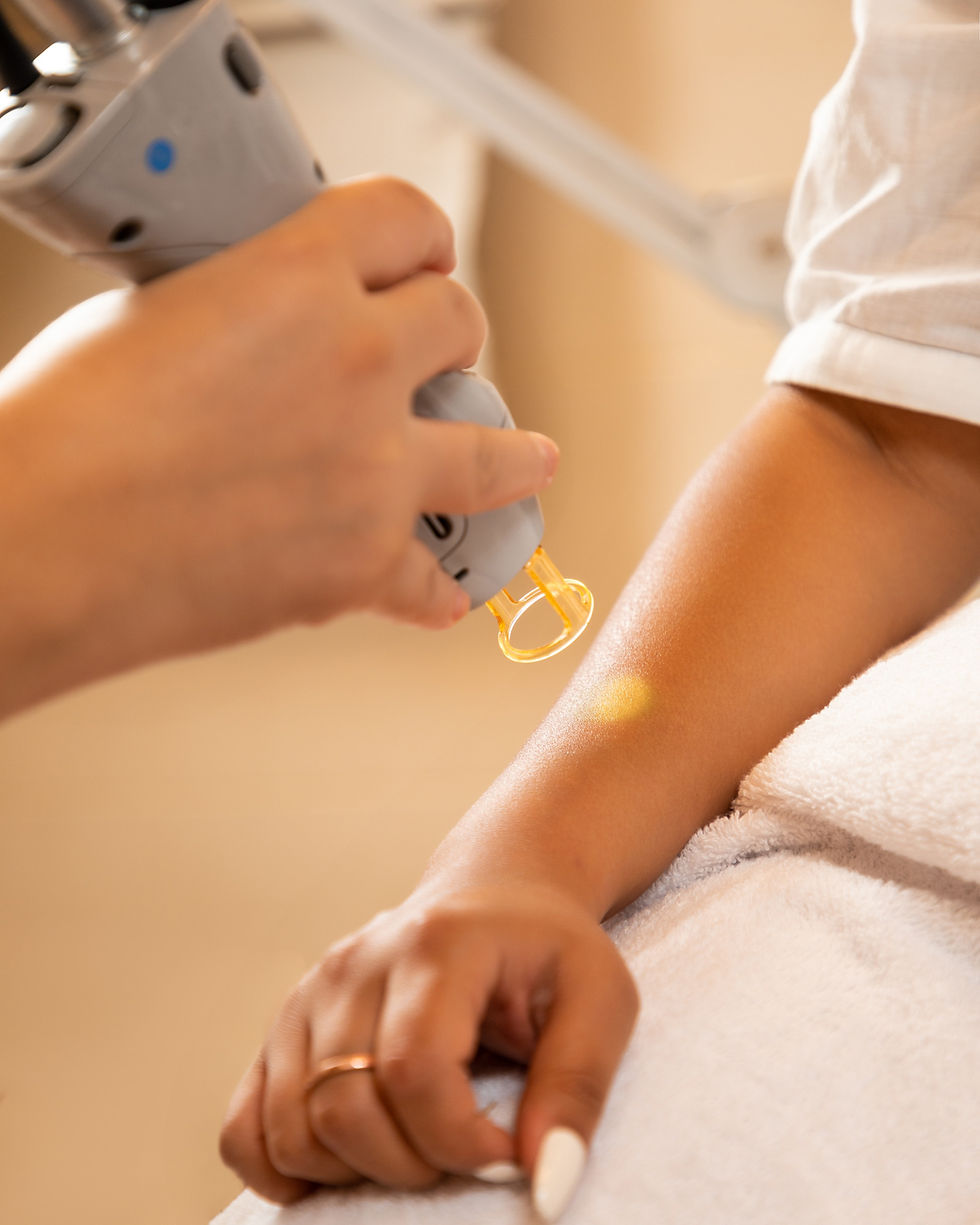
Diode, alexandrite and Nd:YAG are the three main laser technologies used for hair removal. They differ in their wavelength, that is, the "colour" of the light emitted, which determines how strongly it is absorbed by melanin and how deeply it penetrates the skin. Alexandrite (755 nm) is strongly absorbed by melanin: it is effective on fair skin, but riskier on dark skin. Nd:YAG (1,064 nm) is poorly absorbed by melanin: it is the safest on dark skin. The diode laser (800 to 810 nm) sits between the two, which makes it versatile. At the Centre Laser Valbonne, we mainly use the SUBLIM® Mono laser, a diode laser.
What sets the alexandrite laser apart?
The alexandrite laser emits at 755 nanometres. At this wavelength, light is strongly absorbed by melanin, which makes it very effective on dark hair on fair skin (phototypes I to III). On the other hand, on olive or darker skin, the melanin in the skin itself also absorbs a significant share of the energy, with an increased risk of burns and pigmentation marks.
What is specific about the Nd:YAG laser for hair removal?
The Nd:YAG laser emits at 1,064 nanometres. At this wavelength, light penetrates deep into the skin and is only weakly absorbed by the melanin in the epidermis. This is what makes it the safest technology on dark skin (phototypes IV to VI). However, it requires higher energies to destroy the follicle, the session is often less comfortable, and it is less practical for treating large areas.
Why is the diode laser considered versatile?
The diode laser emits between 800 and 810 nanometres. This wavelength offers a good compromise: enough absorption by melanin to destroy the follicle effectively, and deep enough penetration to reach it, while sparing the skin better than alexandrite. It therefore suits a wide range of skin, from the fairest to olive skin. Recent diode lasers also include skin cooling, which improves comfort and allows effective energies to be used.
What about pulsed light (IPL)?
Intense pulsed light (IPL) is not a laser. It emits a broad spectrum of light, not a single wavelength: its action on the melanin in the hair is therefore less selective. It can reduce hair growth, but it is generally less effective than the laser and requires more sessions. It is also less suitable for olive or dark skin, as the melanin in the skin absorbs a larger share of the light. As with the laser, blond, red or white hair responds poorly.
Why did we choose the diode laser?
Comparative studies show that the diode laser is as effective as the alexandrite laser for long-lasting hair reduction. It does, however, have two important advantages. It is much better tolerated: the session is far less painful. And it can be used on slightly olive skin, which is riskier with alexandrite. This led us to choose the SUBLIM® Mono laser, a diode laser, for the vast majority of our treatments. We also have an Nd:YAG laser, which we use occasionally to treat small, darker areas. We treat skin types up to phototype IV. At the preliminary consultation, Dr Milène VERA assesses your phototype, the colour and thickness of your hair, the areas to be treated and your medical history, to check that the treatment is suitable and choose the most appropriate technology.
Can several technologies be combined in a hair removal treatment course?
Yes, it is sometimes useful. In the same person, some areas may be darker than others. Large areas can then be treated with the diode laser, and small, more pigmented areas with the Nd:YAG laser, which is safer on such skin. This choice is made at the consultation.
Frequently asked questions
Which laser technology is best for mixed-heritage skin? For olive to mixed-heritage skin (phototypes III and IV), the diode laser generally offers a good balance between effectiveness and safety. Nd:YAG can complete the treatment on small, darker areas. Each case is assessed at the consultation.
Is Nd:YAG less effective than the diode laser? Not necessarily, but it requires higher energies and is less practical for treating large areas. Its main advantage is its safety on dark skin.
Can I be treated with a diode laser if I have very fair skin? Yes, the diode laser gives very good results on fair skin with dark hair. However, blond, red or white hair responds poorly, whatever the technology.
Does the Centre Laser Valbonne have several technologies? The centre mainly uses the SUBLIM® Mono laser, a diode laser. An Nd:YAG laser is used occasionally for small, darker areas. The centre treats skin types up to phototype IV.
Free and compulsory preliminary consultation — booking via Doctolib. Book an appointment on Doctolib


Comments